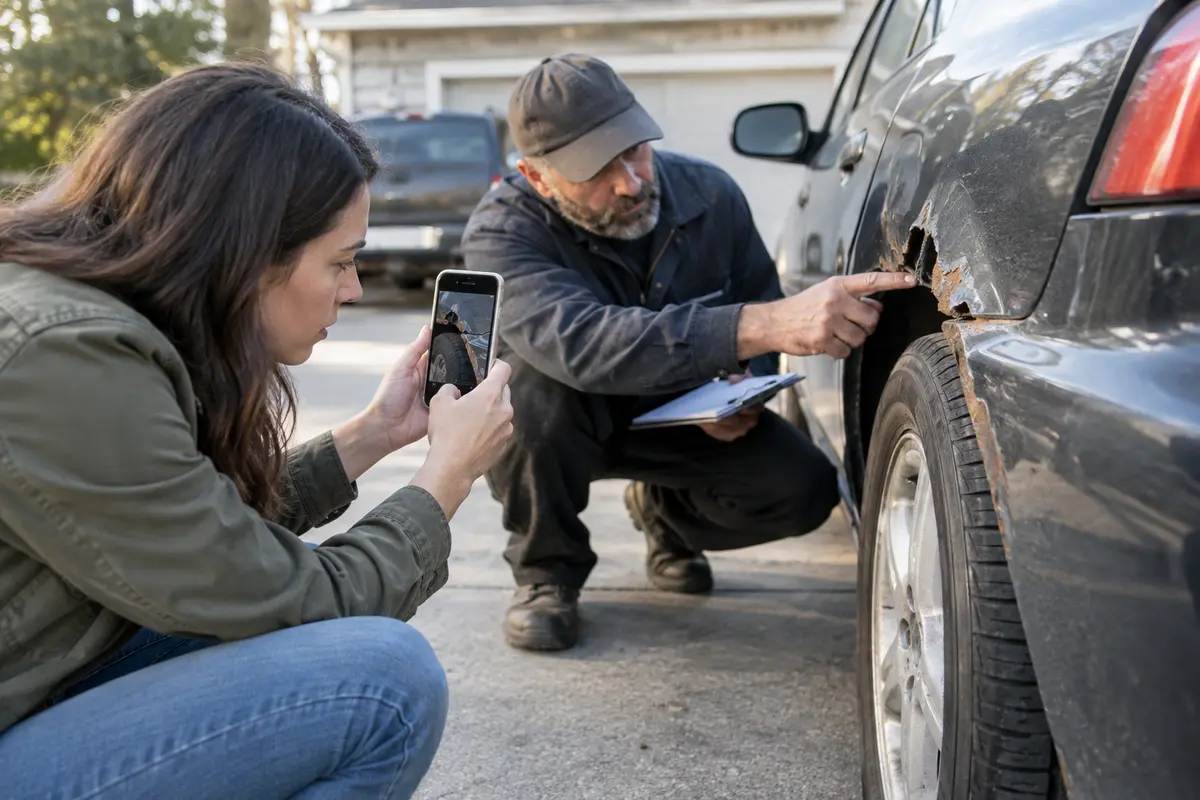
A private seller’s false statement is easiest to evaluate when you can point to the exact words, show why they mattered to your purchase, and connect them to a measurable loss. “Great condition” is vague. “Never flooded,” “the engine was replaced at 72,000 miles,” or “I hold clear title with no lien” are factual statements that can be checked. Start by preserving the listing and messages before they disappear.
Build a representation table instead of an accusation list
| Seller statement | How you can test it | Possible evidence |
|---|---|---|
| “No accidents” | Compare history, body measurements, repair evidence | Saved listing, VHR, body-shop report |
| “No warning lights” | Check current/stored codes and readiness monitors | Scan report, dash video at inspection |
| “New transmission” | Request invoice/serial or shop verification | Receipt, service record, technician inspection |
| “Clean title / no lien” | Check title and state record | Title copy, DMV/lien record |
| “72,000 actual miles” | Trace prior odometer records | NMVTIS/VHR, service invoices, inspection records |
For each statement, write when it was made, who made it, whether it was written or oral, what you did because of it, and what later evidence contradicted it. This exercise prevents a common mistake: mixing ten annoyances with one strong misrepresentation claim. A court or regulator can understand one material false statement with documents more easily than a broad allegation that the seller was dishonest about everything.
Distinguish a lie from an opinion and from a defect the seller may not have known
“This is the best SUV in town” is sales talk. “I have never had a problem with the air conditioning” may be true even if the compressor fails next week. Evidence becomes stronger when the seller had direct knowledge: a prior repair estimate, a message from a mechanic, a title brand, a warning light masked before sale, or a recently erased diagnostic history. The legal meaning of knowledge, intent and reliance varies by state, so do not write your own verdict before collecting the facts.
An as-is clause and a false factual statement answer different questions
A private-sale bill of sale often says the vehicle is accepted as-is. That language can be important to warranty expectations, but it does not magically rewrite a factual history. If the seller disclosed “air conditioning does not work” and the system fails completely, the buyer has a different problem from a seller who wrote “A/C just replaced, receipt included” when no replacement occurred. Let a state-specific lawyer or court decide the legal consequence; your job is to preserve the contradiction.
Put a dollar number on the consequence
Your damages theory should be tied to the lie. If an undisclosed prior collision makes the car worth $2,000 less than represented, obtain market evidence and a repair/body assessment. If the lie caused a $1,100 repair, preserve the invoice and diagnostic basis. If the title cannot be transferred at all, the claimed loss may involve the purchase price and transaction costs rather than merely a repair bill. Avoid padding a demand with unrelated maintenance you would have paid anyway.
A demand letter is stronger when it gives the seller a factual off-ramp
Write a short chronology: “On June 4 you stated X. I paid Y on June 6. On June 8, shop Z documented A and B. Attached are the listing and report.” Then propose one concrete resolution. Do not inflate the letter with legal citations copied from another state. A seller may resolve a $1,500 dispute to avoid court even while denying wrongdoing; a focused demand makes that choice easier.
Choose the forum by the size and kind of dispute
Small-claims court is designed for relatively modest money disputes, but limits and procedures differ by state and sometimes by county. A title dispute, injunction, or claim involving a large vehicle value may require a different court. State attorneys general or consumer offices may accept complaints, though a complaint is not the same as obtaining a judgment. Suspected odometer fraud, forged title, stolen vehicle, or VIN cloning can also implicate specialized federal or law-enforcement channels.
Use the experience to tighten the next purchase process
For a future private sale, ask factual questions in writing before the meeting, compare the seller’s name to the title, run the VIN through official and commercial history tools, scan the vehicle, and pay for an independent inspection when the value justifies it. The goal is not to eliminate all used-car risk. It is to convert the most important promises into things you can verify before money changes hands.
A misrepresentation dispute becomes manageable once you stop asking whether the seller was “a scammer” and start asking five narrower questions: what exactly was said, was it factual, was it false, did it influence the purchase, and what measurable harm followed? Those questions produce the evidence a regulator, mediator, lawyer, or judge can actually use.