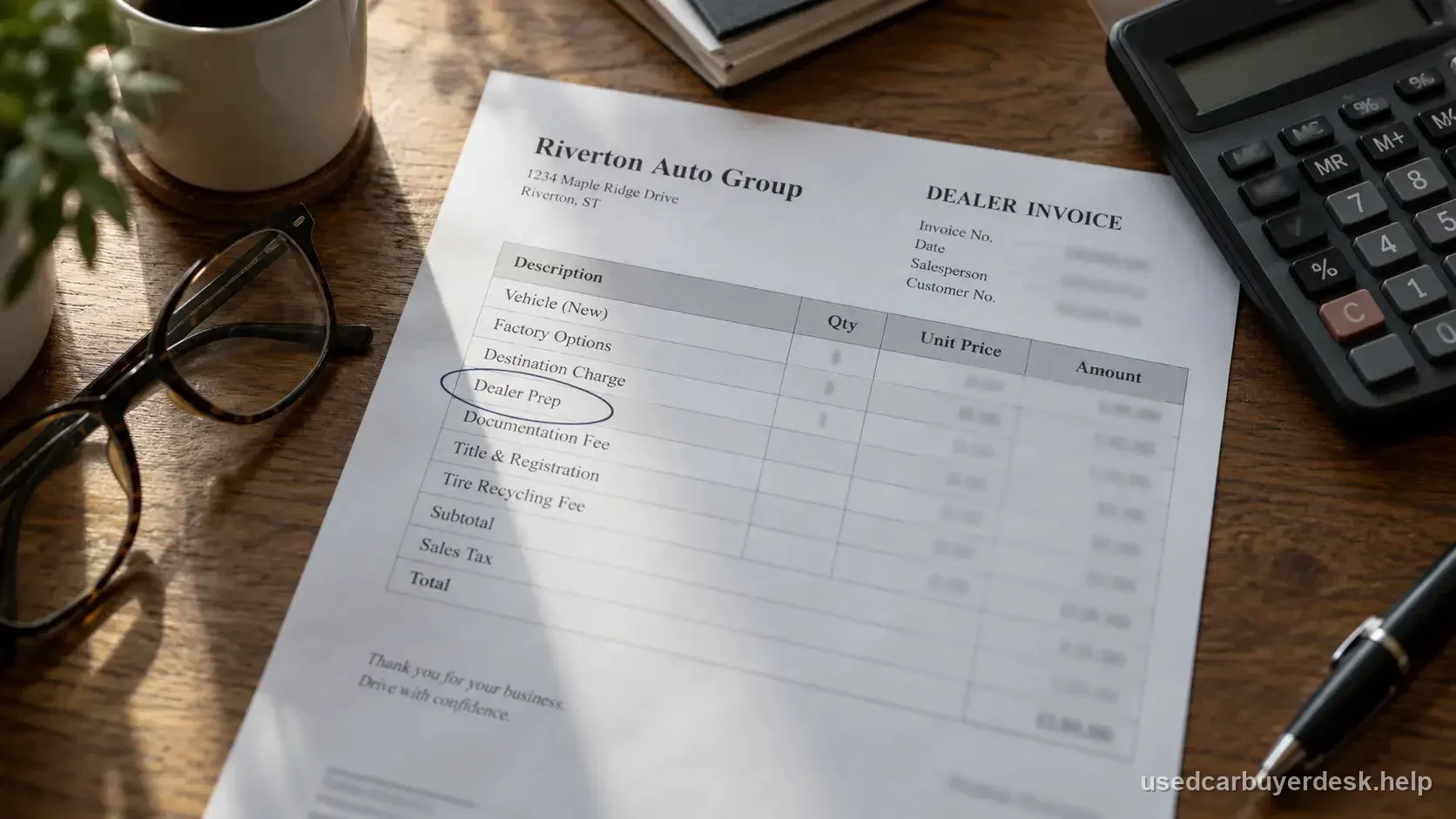
A dealer documentation fee ("doc fee") is a charge for the dealership's paperwork processing — title work, registration filing, and related administrative tasks — separate from the vehicle price, sales tax, and government registration fees. Unlike sales tax, which is set by state law at a fixed rate, the doc fee is set by the dealership itself in states that do not regulate it, which is why the exact same line item can look wildly different depending purely on which state you are buying in.
Roughly half the states cap it, and half do not
About 22 states impose a legal maximum on the doc fee a dealer can charge, while the remaining states leave it uncapped, which is where the largest and most inconsistent charges tend to appear. Even among capped states, the actual dollar limit varies enormously — some of the lowest are under $100, while some of the higher capped states allow several hundred dollars.
| State | Approximate cap | Notes |
|---|---|---|
| California | $85 | One of the lowest caps in the country; a 2025 bill to raise it was vetoed |
| New York | $175 | Fixed statutory cap |
| Washington | $200 | Fixed cap |
| Texas | No fixed dollar cap | Dealers give the state notice of the maximum fee they charge, and the state can review it for reasonableness |
| Illinois | ~$325–380 | Cap adjusts periodically; confirm current figure |
| Florida | No hard cap | Fees commonly reach $699–$799; disclosure rules apply instead of a dollar cap |
In uncapped states, the fee is negotiable in practice even if not by law
Because there is no legal ceiling in roughly half the country, national averages in the $350–500 range (with individual dealers charging $500–999 in the least regulated states) are common, but that does not mean the number on your specific paperwork is fixed. Dealers set their own doc fee as house policy, and while many present it as non-negotiable, some will adjust it as part of overall deal negotiation, particularly if you push back on the total out-the-door price rather than arguing about the doc fee label in isolation.
| State type | What sets the fee | Buyer check |
|---|---|---|
| Capped | A legal maximum that can vary or adjust | Confirm today's limit on an official state page |
| Uncapped | Dealer policy | Treat it as part of total out-the-door negotiation |
| Either type | Dealer paperwork lists the charge | Ask for an itemized quote and compare total cost |
How to actually verify the legal maximum before you sign
- Search '[your state] dealer documentation fee cap' on your state's official DMV or attorney general consumer protection site — avoid relying only on aggregator or blog articles, which can be out of date.
- If your state caps the fee, confirm the exact current dollar amount and ask the dealer to show the fee matches it on your specific paperwork.
- If your state does not cap the fee, treat the doc fee as one more negotiable line item within your total out-the-door price rather than as a fixed government charge — see the companion guide on out-the-door pricing for how to negotiate the whole number rather than fee-by-fee.
- Ask the dealer directly whether the quoted doc fee is their standard fee for every sale or something added specifically to your deal — a fee that varies by customer, rather than being a flat posted rate, is worth pushing back on.
What the doc fee is not
It is separate from state title and registration fees (paid to the government, not the dealer), separate from sales tax, and separate from any optional add-ons like extended warranties or paint protection. If a single lump-sum number on your paperwork is described only as "fees" without breaking out the doc fee specifically, ask for an itemized breakdown — bundling makes it harder to check any individual line item against your state's actual rules.
Comparing the total out-the-door price, not the doc fee in isolation
One negotiating trap worth avoiding is treating the doc fee as a battle to win or lose on its own, separate from the rest of the deal. Some dealers will hold firm on a high doc fee while quietly offering a better price on the vehicle itself, or vice versa — the doc fee is one line item in a total number, and a dealer with room to move can shift where that room shows up on the paperwork. Negotiating the vehicle price down while accepting a padded doc fee can leave you no better off than negotiating a higher vehicle price with a lower fee, if the bottom-line total is the same either way.
The practical fix is to ask for the full out-the-door price early in the conversation — the total you'll actually pay including the vehicle price, doc fee, any other dealer fees, taxes, and title/registration costs — and negotiate that single number rather than negotiating each line item separately. This also makes it much easier to compare offers between dealers, since two dealers can advertise the same vehicle price while having very different total costs once fees are included.
When comparing multiple dealers on the same or similar vehicles, ask each one for a written out-the-door quote before you visit in person, and be explicit that you're comparing total cost, not just sticker price. A dealer unwilling to provide this in writing before you arrive is worth treating with some caution, since it can be a sign they intend to build the real number once you're already invested in the visit.
It also helps to time your ask correctly: request the out-the-door number before you reveal whether you plan to finance or pay cash, and before discussing a trade-in, since bundling multiple negotiable variables together makes it much harder to see whether the doc fee itself is being padded to offset a concession made somewhere else in the deal.
- Request each written out-the-door quoteAsk before discussing financing or trade-in.
- Include every costVehicle price, doc and dealer fees, taxes, title, and registration.
- Get the fees itemizedA lump-sum "fees" line makes any single charge harder to check.
- Compare totals across dealersA lower fee label does not guarantee a lower final price.